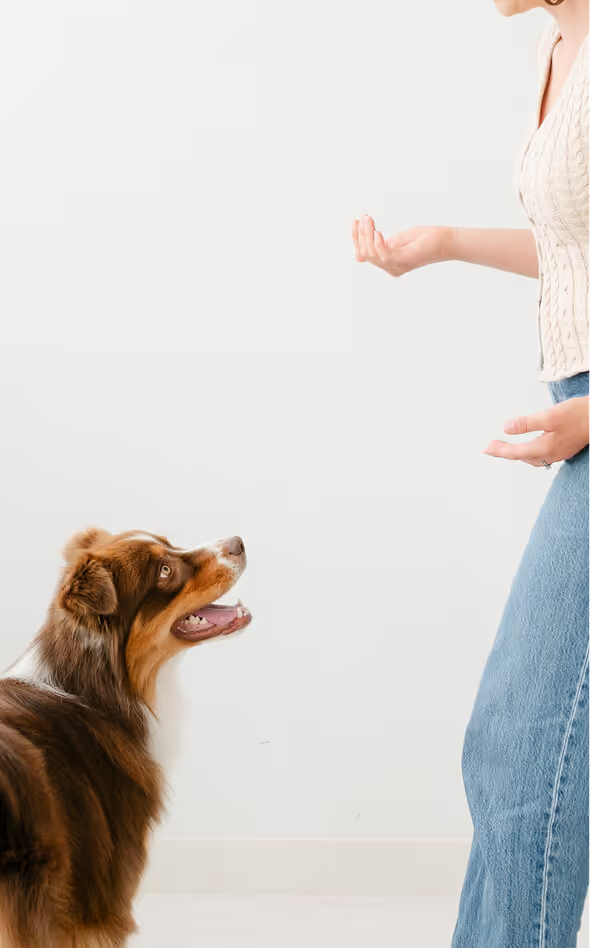
The interesting (and sometimes uncomfortable) parallels between high-drive dogs and high achievers




Have you ever gone on a five-mile run with your dog, spent the afternoon doing enrichment, worked on training, played fetch, and somehow still felt like you haven't done enough?
Are you spending hours on Reddit threads, watching yet another training video on Instagram and ordering an enrichment toy at 1am that promises to help your dog "chill out"?
Or maybe you're the person who gets an incredible amount done in a day and still goes to bed feeling unproductive or even lazy.
If any of this sounds familiar, I have a little theory I want to share.
After years of working with high-achieving dog guardians and their high-drive dogs, I've noticed an interesting pattern: Sometimes, the people who gravitate toward high-drive dogs have quite a few things in common with them.
And sometimes, living with a high-drive dog can feel a little like looking in a mirror.
Disclaimer: This is a personal observation based on years of working with high-achieving dog guardians and their high-drive dogs. Not a scientific study or a universal rule, but a pattern I've noticed over and over again. Our dogs' behavior should always be looked at holistically and in context. There are many factors influencing behavior, and our dogs deserve to be understood in their own right, too.
The high-achiever and the high-drive dog
Let's start with some similarities.
Sound familiar?
- Getting way more done than the average person and STILL feeling lazy.
- Always looking for the next thing to do.
- Having a hard time switching off.
- Getting frustrated when things don't happen fast enough.
- Thriving on stimulation, novelty, and having a purpose.
- Feeling guilty when you're doing absolutely nothing.
Now, are we talking about you or your dog?
Of course, human ambition and canine drive aren't exactly the same thing. But there are some interesting parallels when it comes to motivation, stimulation, frustration, and the ability to rest.
We admire our dogs for their determination, intensity, enthusiasm, and willingness to work.
We might even celebrate those same qualities in ourselves.
But what happens when neither of us knows how to switch off?
We want our dogs to slow down. But do we?
Here's where I think things get particularly interesting.
We spend so much time trying to teach our high-drive dogs to settle, relax, disengage, and regulate their emotions.
And yet, many of us simultaneously glorify our own busyness, productivity, and ability to always be ON.
We're proud of being busy. We love having a full calendar. We enjoy having projects, goals, and things to accomplish.
Sometimes, doing nothing feels uncomfortable. Rest can feel unproductive. And even when we've accomplished a lot, there's always something else on the list.
So here's a question:
Are we asking our dogs to master something that we haven't quite figured out ourselves?
I'm not saying that our dogs need us to become perfectly regulated humans before we can help them. Far from it.
But I do think there's something valuable in recognizing the patterns we might share.
When our dogs hold up a mirror
This brings me to something a little more psychological.
Have you ever noticed that certain behaviors in your dog trigger you WAY more than others?
Maybe it's their inability to relax. Their constant need for stimulation. Their intensity. Their frustration when things don't go their way.
Sometimes, the behaviors that frustrate us most in others can touch on things we struggle with ourselves.
There's actually a psychological concept for this: projection.
Projection describes a process in which we attribute feelings, traits, or tendencies within ourselves to someone else, sometimes without realizing it.
Carl Jung explored a related idea through what he called the shadow: the parts of ourselves we tend to suppress, reject, or keep out of sight.
Now, I'm not suggesting that every frustration we experience with our dogs is psychological projection. Sometimes a behavior is simply challenging. Sometimes we're exhausted, overwhelmed, or dealing with a genuinely difficult situation.
But I think it's worth getting curious about our reactions.
For example:
- Does your dog's inability to switch off feel particularly frustrating because you struggle to do the same?
- Does their constant need for stimulation remind you of your own restlessness?
- Does their frustration when things don't go as planned bring up something familiar?
- Do you find yourself pushing for more activity, more training, and more progress because slowing down feels uncomfortable for you, too?
Sometimes, our dogs hold up a mirror. And what we see might surprise us.
The problem isn't drive. It's the lack of flexibility.
Now, I want to make something very clear:
I don't think high-drive dogs need to become less driven.
Drive can be an incredible quality. It's part of what makes many working and herding breeds so capable, motivated, intelligent, and enjoyable to work with.
The same traits that make a Border Collie exceptional at their job can make modern pet life challenging.
But being able to DO something doesn't automatically mean being able to:
- Disengage from stimulation.
- Tolerate frustration.
- Pause before reacting.
- Recover after excitement.
- Adapt when things don't go as planned.
- Feel comfortable doing absolutely nothing.
These are different skills.
A dog can be incredibly intelligent, motivated, and eager to work while still struggling with emotional regulation and recovery.
And this is where I think we sometimes get things backwards.
We see a dog who struggles to settle and respond by adding MORE.
More activities. More enrichment. More training. More stimulation. More challenges.
Because we think a tired dog is a fulfilled dog.
And while appropriate physical and mental outlets are incredibly important, sometimes what our dogs need isn't another activity.
It's help learning how to come back down.
It's building the capacity to disengage, recover, and feel comfortable in the absence of constant stimulation.
What if we got a little curious instead of frustrated?
I think one of the most valuable things we can do as dog guardians is become more aware of our own expectations, habits, and reactions.
Not to blame ourselves for our dogs' behavior.
Not to assume that everything comes down to our own nervous system or lifestyle.
And certainly not to overlook the dog's individual needs, genetics, health, history, or environment.
But to recognize that the human-dog relationship is exactly that: a relationship.
Both sides influence the dynamic.
So the next time you find yourself getting particularly frustrated with your dog's inability to slow down, maybe take a moment to ask yourself:
- Am I actually comfortable doing nothing?
- Do I equate being busy with being productive or valuable?
- Am I expecting my dog to regulate in ways I struggle with myself?
- Am I constantly looking for the next thing, too?
- Am I allowing both of us enough time to rest and recover?
Sometimes, a little self-awareness can change the way we approach our dogs.
Less intensity? Not necessarily. More balance.
My goal isn't to turn high-drive dogs into low-energy dogs.
It's not about taking away their enthusiasm, curiosity, motivation, or personality.
It's about helping them develop the skills to navigate the world with more flexibility.
To be excited without becoming overwhelmed.
To work hard AND rest.
To enjoy stimulation without constantly needing more of it.
To be able to switch between activity and recovery.
And honestly? I think some of us humans could benefit from practicing those things, too.
Maybe our high-drive dogs aren't here to teach us how to be MORE productive.
Maybe they're teaching us something about balance.
How to work hard without always being ON.
How to be enthusiastic without being frantic.
How to enjoy doing nothing without feeling like we're missing out.
Sometimes, our dogs hold up a mirror. And maybe that's one of the most interesting parts of living and growing alongside them.
This is actually one of my favorite parts of working 1:1 with clients: looking beyond the behavior itself, connecting the dots, and exploring the bigger picture of the human-dog relationship.
Because sometimes, the biggest breakthroughs happen when we start understanding not just our dogs, but ourselves, too.
If you're looking for this kind of deeper, individualized support for you and your dog, I'd love to work with you. Start with a free discovery call.
"Bianca truly gets to the root of the problem."
"Hands down, Bianca is the best and most experienced dog trainer on so many levels--she's more than a trainer--she truly gets to the root of the problem. We've worked with several trainers over the years, and we've never had one with such an incredible disposition and strong animal behavior acumen. Her feedback, tips and overall approach made everything feel achievable. The analogies Bianca uses truly help things click—we finally understood the why behind the training. We've always felt overwhelmed by dog training in the past, but this was easy to grasp, practical, and made complete sense. She's made our home of four dogs much more pleasant and calm!"
"Bianca truly gets to the root of the problem."
"Hands down, Bianca is the best and most experienced dog trainer on so many levels--she's more than a trainer--she truly gets to the root of the problem. We've worked with several trainers over the years, and we've never had one with such an incredible disposition and strong animal behavior acumen. Her feedback, tips and overall approach made everything feel achievable. The analogies Bianca uses truly help things click—we finally understood the why behind the training. We've always felt overwhelmed by dog training in the past, but this was easy to grasp, practical, and made complete sense. She's made our home of four dogs much more pleasant and calm!"
Keep learning what helps your dog thrive




Questions?
I'm here.
Feel free to send a message.